Introduction to 2D sediment modeling
Any referenced datasets can be downloaded from "Module downloads" in the module overview.
Video quiz
Step-by-step guide
In ICM, sediment modeling simulates and predicts sediment transport and deposition patterns, informing decisions in key areas of river management, such as managing flood risk.
Understanding river processes, sediment loads, and the Shields parameter is essential for effective sediment modeling.
River processes
These include several dynamics:
- Erosion occurs when water flow has enough energy to carry particles from the riverbed or banks.
- Sediment transport is the process of water flow carrying sediment particles downstream, through the suspension of fine particles, rolling, saltation, sliding, or traction.
- Sedimentation occurs when transported sediment settles out as the flow velocity decreases.
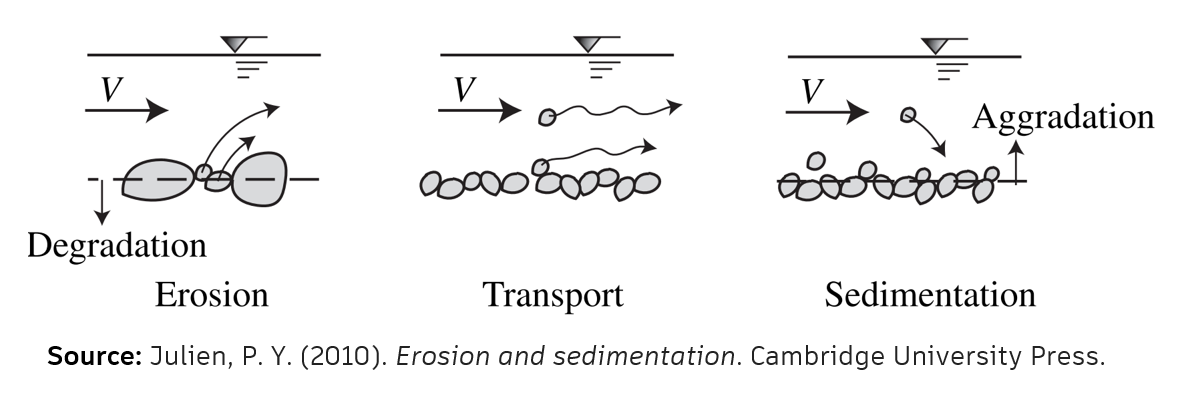
Types of sediment loads
Sediment loads in a river are categorized by how sediment is transported.
- Bedload: Sediment transported along the riverbed by rolling, sliding, or saltation; typically larger, heavier particles not easily suspended in the water column, such as sand, gravel, and pebbles.
- Suspended load: Finer particles, such as silt and clay, carried within the water column and that can remain suspended by turbulence.
- Total load: The sum of bedload and suspended load in a river.
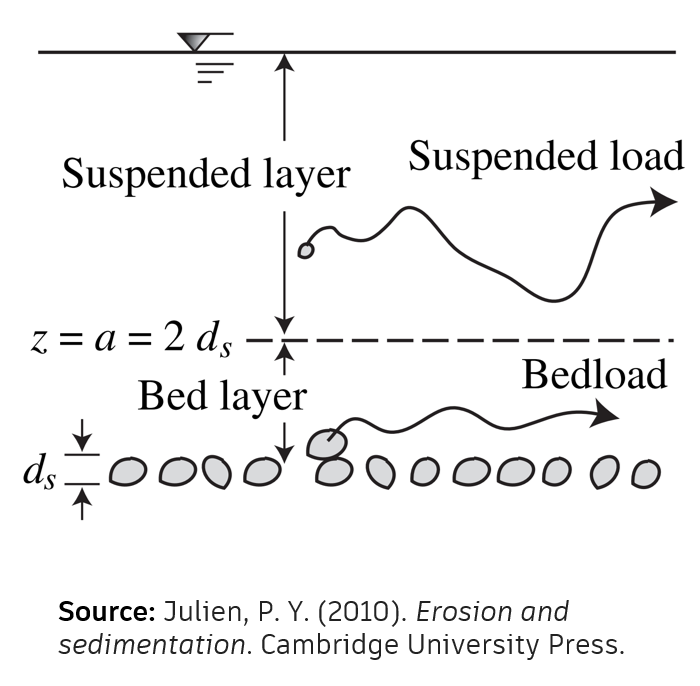
Incipient motion of particles
The Shields parameter (𝜃) is a dimensionless number that determines when sediment particles start moving due to the balance of bed shear stress, gravity, and friction. It is calculated using the following formula:

- 𝜏 represents bed shear stress
- 𝜌𝑠 and 𝜌 represent sediment and fluid densities
- g represents gravitational acceleration
- D represents particle diameter
The graph below shows how the critical Shields parameter varies with the flow regime, transitioning from laminar to turbulent flow.
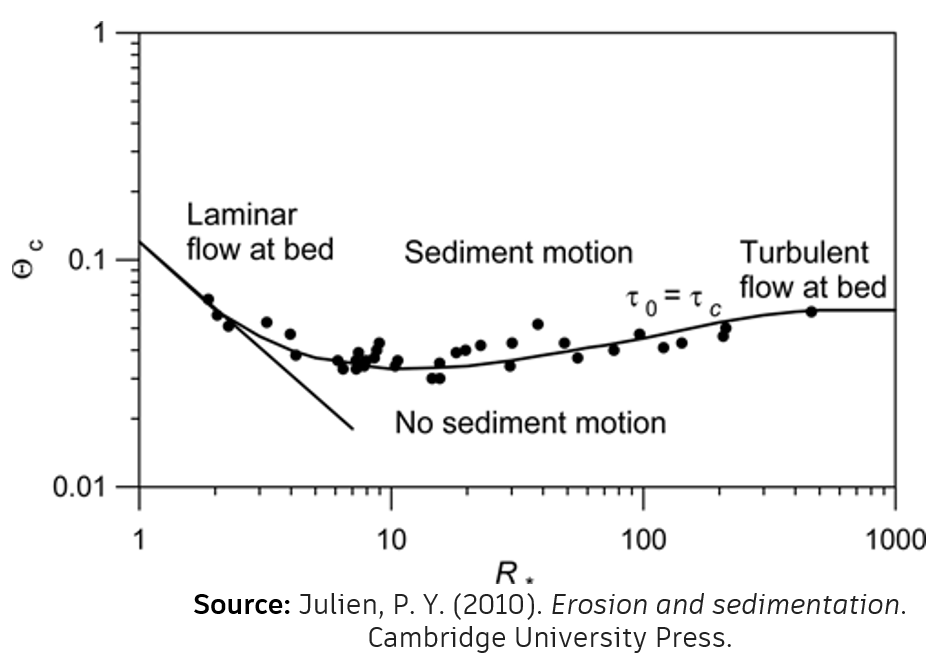
The Shields parameter is essential in predicting if sediment is transported.